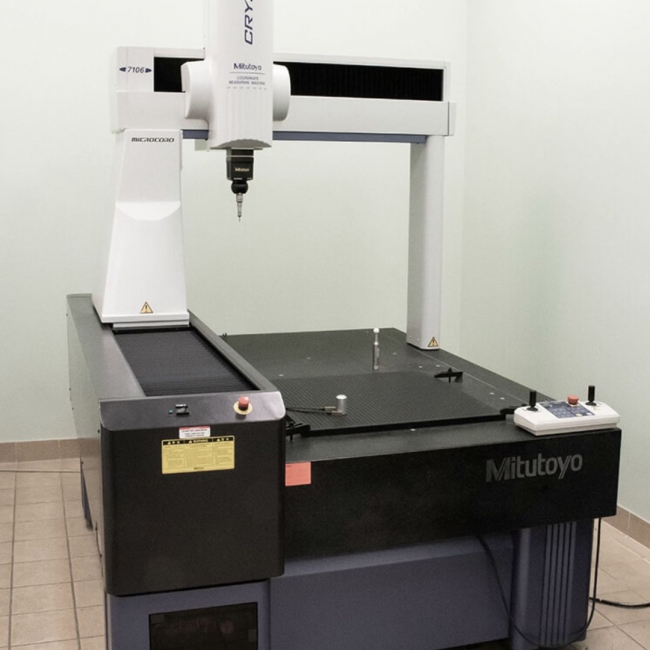
Coordinate measuring machines (CMM) aid in precision machining by offering quality assurance, complex inspection, process improvement and verifying geometrical dimensioning. RWD Tool & Machine Ltd., a leading CNC machine shop in Vaughan, Ontario, explores these features in detail in this blog.
Precision machining is desired in metal fabrication because of its strict adherence to tight tolerances. This is key to ensuring high performance and safety in numerous applications. To make sure that the parts produced adhere to these tolerances, CMMs are used to validate parts. Hence, they are a key part of quality assurance in precision machining.
Traditional tools can also check part dimension accuracy in some cases. However, in the case of precision machining, there are a lot more challenges in the form of complexity. Manufactured parts feature holes, grooves or complex 3D contours which are very difficult to inspect by traditional means. However, with a CMM, this inspection can be conducted with ease and high accuracy. \
By constant measurements and accurate data, CMM can also improve the overall CNC machining process. When integrated with Industry 4.0 tools, they can monitor part quality in real-time, further helping the precision machining process by reaching new levels of accuracy.
Various geometrical dimensioning features, such as parallelism, circularity or flatness, can also be checked easily by means of a coordinate measuring tool. This comprehensive level of part inspection is only possible using these machines.
To summarize, coordinate measuring machines (CMMs) are a key part of precision machining as they ascertain accuracy, improve the process and enable complex inspection.
Need your parts inspected and validated? RWD Tool & Machine Ltd. can deliver. We are a CNC machine shop offering high-quality precision machining and metal fabrication services such as drilling, milling, turning, welding, and more, aside from using CMMs to check for tolerance deviations. Contact us at 905-738-1050 today for more details.
The different types of coordinate measuring machines include bridge, gantry, cantilever, horizontal arm and portable.
Controlling operating temperatures, regular calibration and maintenance help improve accuracy in coordinate measuring machines.